
ArchiMate Relationships Part 2: The Composition Relationship in Aviation
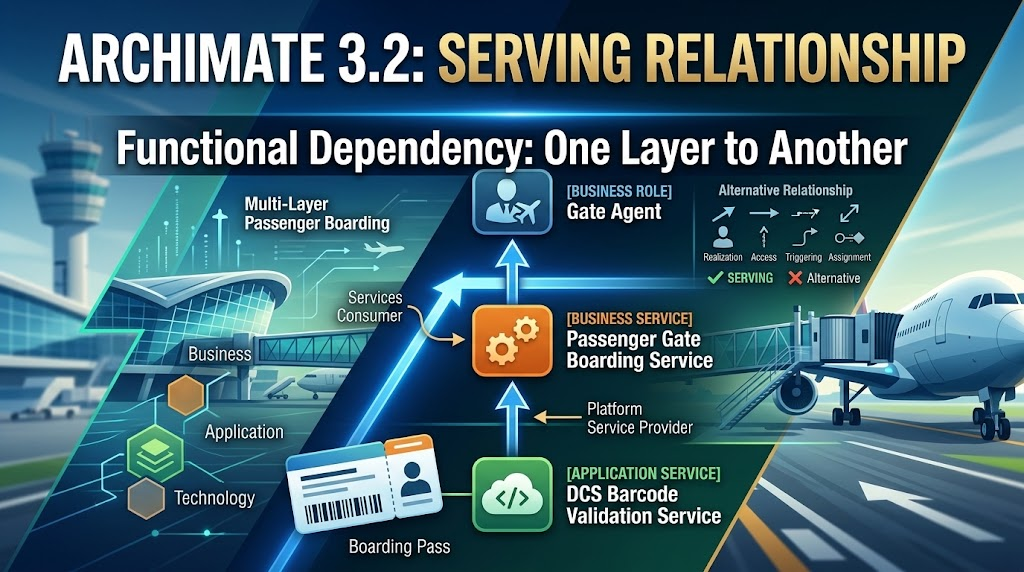
Welcome to Part 2 of our 10-part ArchiMate series! In Part 1, we covered how the Serving relationship links services to the roles and processes that consume them.
Today, we delve into structural decomposition using the Composition relationship.
What Is the Composition Relationship?
In ArchiMate 3.2, the Composition relationship models a strict whole-part relationship where one element consists of smaller sub-elements.
- Notation: A solid line with a filled diamond at the parent (“whole”) element end. Alternatively, nested boxes inside a parent container implicitly represent composition.
- Core Semantics: Existence dependency. If the parent element is removed, the child elements typically lose their operational context within that scope. The part can belong to only one whole at a time in a given viewpoint.
Aviation Example: Airline Departure Process
A flight departure is not a single atomic event; it is an overarching business process comprised of distinct operational phases. Let’s model the Departure Process and its subprocesses.
Explicit Structural Decomposition:
- Parent Element:
Flight Departure Process(Business Process) - Child Elements:
Passenger Check-In Process(Business Process)Security & Passport Control Process(Business Process)Gate Boarding Process(Business Process)
If the airline cancels or redesigns the overarching Flight Departure Process, these subprocesses lose their defined trigger sequence within this operational flow.
Why Other Relationships Do Not Fit Here
Architects often confuse Composition with Aggregation, Triggering, or Specialization. Here is why those alternatives fail when defining a whole-part process breakdown:
| Relationship | Why It’s Wrong in This Context |
|---|---|
Aggregation (o--) |
Aggregation represents a loose grouping of elements that can exist independently outside the parent (e.g., a portfolio of independent applications). In our example, Gate Boarding is an integral, mandatory component of the specific flight departure workflow. |
Triggering (--->) |
Triggering models the temporal sequence between subprocesses (e.g., Check-In triggers Security Screening). While triggering shows the timeline, Composition defines structural ownership—which process contains them both. |
Specialization (--|>) |
Specialization represents an “is-a” type inheritance (e.g., Priority Boarding is a special type of Boarding). Security Screening is not a type of Flight Departure; it is a phase within it. |
Real-World Value in Enterprise Architecture
Understanding process composition is crucial during business process re-engineering (BPR) or core system migrations (such as updating an airport’s operational database).
By clearly mapping process composition:
- Enterprise Architects can calculate complete end-to-end process latency by summing composed subprocess durations.
- Ownership and governance can be assigned effectively (e.g., Airport Authorities owning Security Screening, while Ground Handlers own Gate Boarding).
- Solution Architects can cleanly scope API boundaries for underlying IT automation.
Coming Next
In Part 3, we will explore the Realization relationship. We will look at how underlying IT components and application services realize higher-level business requirements and services.
Thank you for reading! Leave your feedback or questions in the comments below.
Comments